Thursday, 10 May 2012

THE BARBICAN!


Back to drawing buildings. My friends know that for a long time I have wanted to do something on The Barbican, not quite finding out the way of being true to this fascinating building complex. After my first visit in autumn 2008, when I had recently arrived in London, it made me think of a sci-fi set up in which it was the only civilised remnant in a dystopian future London, like a sort of a Noah's ark of culture among devastation.

However, like the Transformers there's so much more than meets the eye, and so massive it is the Barbican is full of secrets, hidden spots and nooks, a bit of a metaphor of London itself. So after many times wandering around the estate in my spare time, I went back to basics and, drawing inspiration from early works, resumed with the idea of giant straight forward Modernist creatures, something in between monsters and robots wreaking havoc on London. No hidden meaning, just postmodernist fun.

THE BARBICAN! is one in a set of three postcards, with one of the towers portrayed as some sort of Brutalist Godzilla with a dangerous aversion to Classic architecture.

Thursday, 12 April 2012

Secret London


I'm glad that last week I managed to submit my entry to the Secret London competition run by Serco and the AOI. Illustrating hidden aspects of the capital immediately appealed me and spent long time thinking about which part of London to focus on, finally deciding to do it on an area I know well, the East End.

An aspect of London that keeps surprising me is the amazing streets and squares that remain tucked away off main roads, that seem to be only for the locals' pleasure as someone non-familiar with the area would hardly venture off the high street unless I imagine to see a friend... In my case, a bike opened me this world that makes quite a contrast with my hometown Barcelona, where shops and bars are scattered about so it's easy to find oneself looking around deep parts of the district.

This illustration is a mind map of the East End as it is in my head after 3 years living and cycling about in Tower Hamlets. Stepney then, is in the centre of the map and around it different aspects of life in the area, covering past and present and focusing on culture, people and food. The colours in the background are those of the Underground lines that serve the area, mainly the Overground, DLR and the District and Central lines. Blue in the middle shows the area of influence of a bike with which one can go anywhere and is the healthier and greener way to enjoy the hidden gems of this rich and not so much known part of London.

Wednesday, 28 March 2012

Exploration


One of the things I enjoy most doing is exploring. The day I went to the Richard Long exhibition at Tate Britain back in the summer of 2009 it opened my eyes the way he creates art out of his walks in the wilderness. It showed me a way of relating my walks and cycle rides with my architecture illustration work. It is during one of these long random walks or the day I cycle to somewhere new or divert form my usual routes that I might see something that would give me an idea for my next illustration. I some times do a few sketches but I normally end up taking more photos of inanimate things than is healthy. I might later use them in a digital collage.
This image is from the day I went out to discover the area around Battersea Park. Starting and ending in Victoria station my only destination was the park so I walked following my intuition only. Once back at home I mapped the route on Google Earth and got this abstract shape. I find it very interesting as it can say a lot about one’s personality and interests in a way.


Wednesday, 21 March 2012

The Magic Indian Scene


Recently my friends of The Destroyed Room contacted me for a quick turnaround job to design a screenprint poster to go with their first LP album The Magic Indian Scene. One of the songs is about some lost boys dressed up like Indians riding around the city on their bikes without anybody seeing them. That’s how they came up with the idea for a coloured Indian feather and in the end it turn out to be blood stained. The lettering is painted using a stick with thick black paint, as I imagined it on a rock by a warrior going to war. It actually was paper, but it would have been substantially cooler the other way. The feather is drawn with a dip pen and yes, Indian ink.
This Friday The Destroyed Room are performing in La[2] de Apolo in Barcelona at 12.30am.

Hace poco mis amigos de The Destroyed Room me llamaron para diseñar una serigrafía para su primer LP The Magic Indian Scene. Una de las canciones habla de unos niños perdidos vestidos de indio que recorren la ciudad en bicicleta sin que nadie los vea. Así es como surgió la idea de una pluma de indio coloreada. Al final resultó estar manchada de sangre. La tipo está pintada con un palo y pintura negra espesa sobre una roca, tal y como yo lo imaginé por un guerrero antes de una batalla. En realidad era un papel, pero lo de la roca hubiera molado más. La pluma está hecha a plumilla con tinta china.
Este viernes The Destroyed Room tocan en La[2] de Apolo en Barcelona a las 00.30h.

Wednesday, 14 March 2012

Golden Lane Estate


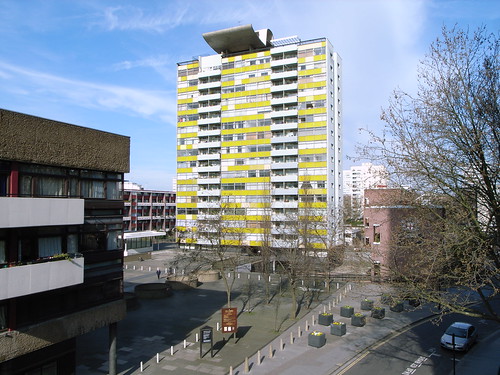
Hardly noticed when compared to the neighbouring Barbican Estate, it’s hard to imagine the importance of the Golden Lane Estate (1957) as one of the first social housing schemes that in a matter of years would change the shape of the English landscape for good.
Designed by architects’ firm Chamberlin, Powell and Bon to house residents of the Cripplegate area after devastation of the City of London in The Blitz during World War II, once finished it became a symbol of Post War recovery and a referent for council housing across England. The fact that King Arthur House – in the image – was for a brief period the tallest tower block in England shows the ambition of the project.
However it would soon be surpassed by the massive scale of the Barbican Estate, built by the same architects immediately afterwards in a regeneration process that took almost 20 years to complete. It’s fascinating we can still look at Golden Lane Estate, as a surviving urban microcosm utopia at a time of architectural disenchantment.
See King Arthur House here.
Golden Lane Estate is postcard five of six designed for Bauhaus: Art as Life competition at the Barbican Centre.